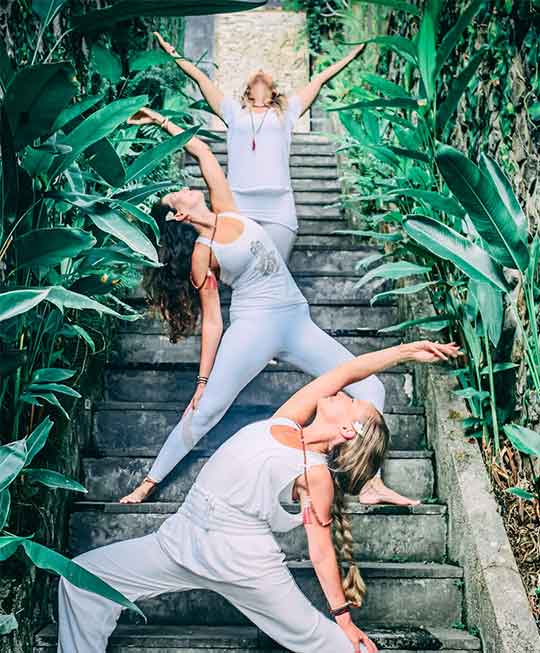
Never done yoga teacher training before? It’s easy to picture your days in Bali as long yoga sessions with plenty of free time after. The reality usually looks different. A Bali yoga teacher training course often mixes physical practice with classroom study. Discussions, teaching practice, and independent work fill in the rest, often all within the same day.
Every school runs things a little differently, and the type of course matters too. A residential program follows a different schedule than a non-residential one. An intensive program can feel nothing like a course spread across a longer stretch of time. Still, most teacher training programs share one thing: your days lean much more toward learning than a normal yoga retreat ever would.
Your Day May Start With Yoga Practice
Many programs open with a morning practice. It can start early, especially during an intensive course, and often ranks among the more physically demanding parts of the day.
Completing a long sequence isn’t really the point. You’ll likely get asked to pay closer attention to your breathing and alignment. Transitions and pacing matter too, along with how instructions actually get delivered. As training moves forward, you may start watching class differently. Your attention shifts too. Rather than focusing only on how a pose feels in your own body, you start noticing why the teacher picked a particular sequence, or how one instruction helps a student grasp a movement.
School to school, the style of practice varies. Some center on Vinyasa. Others lean toward Ashtanga or Hatha, or something else entirely. This is exactly why a school’s teaching style matters when you pick a course.
Your Time Is Not Spent Only on the Mat
Morning practice often leads into other subjects. Anatomy and physiology often come next. So does yoga philosophy, meditation, pranayama, sequencing, or teaching methodology, filling out the rest of the day.
These classes feel nothing like your physical practice. You might spend part of the morning discussing how the body moves, then shift into yoga philosophy, or learn how to structure a class, later that same day. Some days lean more physical. Others demand more reading, discussion, or preparation.
First-time trainees tend to underestimate this part. A 200-hour yoga teacher training Bali program isn’t just 200 hours of doing yoga poses. Yoga Alliance’s current RYS 200 standards cover four broad areas: Techniques, Training and Practice; Anatomy and Physiology; Yoga Humanities; and Professional Essentials. Schools assess trainees on their knowledge and skills too, before handing out a 200-hour training certificate.
In other words, mental energy matters here just as much as physical energy. You might finish morning practice feeling wiped out, only to find the afternoon holds several more hours of concentrated study.
Teaching Practice Changes the Experience
As training continues, more focus shifts toward actually learning to teach. You’ll practice giving verbal cues and demonstrating poses. You build short sequences too. You also watch other students, or teach part of a class yourself.
For a lot of trainees, this part feels nothing like a regular yoga class. You might know a pose well and still find it hard to explain to someone else. A sequence that feels easy on your own can get much harder when you have to guide a group through it.
That is actually the point. Teaching practice gives you a chance to try, get feedback, and improve. You are not expected to teach perfectly on day one. It is about becoming more aware of how you speak, demonstrate, observe, and respond to students.
Breaks and Rest Are Part of the Day
A full training day needs room to breathe. Depending on the school, you might get time for breakfast and lunch. Short breaks between classes come up too, and sometimes a longer stretch to actually rest.
No single timetable applies across every yoga school in Bali. Yoga Alliance caps instructional hours, but schools still arrange their schedules however works for them. For RYS programs, Yoga Alliance currently allows no more than 14 instructional hours a day.
That line between instructional hours and everything else actually matters. Yoga Alliance doesn’t count homework or reading assignments as instructional hours. Personal practice and public classes don’t count either, under the current RYS 200 framework.
So if you’re comparing a yoga teacher training Bali 2026 program, don’t judge the workload by the hour count alone on the course page. Ask for a sample timetable instead. Find out how much of your day sits in actual classes, how much breathing room exists between sessions, and whether regular days off show up anywhere.
Evenings May Involve More Study
The last scheduled class doesn’t always mean the learning stops there. Some programs pack in reading, assignments, or lesson planning after hours. Preparation for teaching practice often lands here too.
You might review anatomy notes one evening, prepare tomorrow’s sequence the next, or read up on yoga philosophy. Other evenings might be completely open. It really depends on the school and how the program is built.
You Can Still Experience Bali
Intensive doesn’t automatically mean you’re stuck inside the training space from morning to night. Breaks and free periods show up in plenty of programs. Some even build in full days off.
Free time depends on the course you pick. A shorter, more intense program usually leaves less room for sightseeing than a longer, easier one does.
Set your expectations early, before you even arrive. You can still enjoy Bali, but the training should stay your main focus. A beach visit might fit in, or a meal outside the school. An afternoon exploring the area too, maybe. Just don’t expect the freedom of a regular holiday here.
What Should You Expect Overall?
A typical day in yoga teacher training covers far more than yoga practice alone. You might start with asana practice, move into studying anatomy or philosophy, work on teaching skills, and take in feedback, then close the day out with reading or preparation.
The routine can feel demanding, but that’s exactly what sets teacher training apart from regular classes. You’re not just learning how to perform poses here. You’re learning how to understand the practice on a deeper level, and how to actually communicate it to other people.
Before choosing your yoga teacher training Bali program, ask the school for a sample daily schedule. Find out when practice starts. Ask how long the teaching sessions run, and how much teaching practice actually gets included. Ask about breaks and free time as well. All of this helps you picture what the experience will actually feel like.
About The Author
